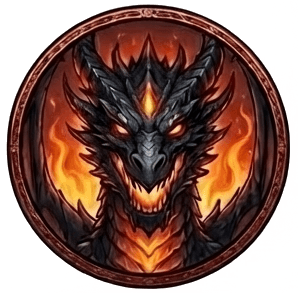
Before she became the terror of Hokrish Mountain, Utaria was something else entirely. She was a guardian, yes, but also a dreamer—a being of pure flame who believed that even the most dangerous creatures deserved mercy.
The centaur came to her mountain in chains. His name was Kovren, and he had been captured by human soldiers who intended to sell him to the fighting pits of the eastern cities. They made camp at the base of Hokrish, not knowing whose domain they had entered. Utaria descended on them like a sunset turned violent. The soldiers burned. The centaur remained.
She should have killed him. That was her way—no intruders survived the mountain. But something in his eyes gave her pause. They were silver, like moonlight on water, and they held no fear. He looked at her—this creature of smoke and ember and ancient wrath—and he smiled.
"You're lonely," he said. It was not a question.
She imprisoned him in a cage of obsidian, deep in the volcanic chambers beneath her peak. She told herself it was for later, that she would consume him when she grew hungry. Days passed. Then weeks. She found herself visiting his cage, listening to his stories of the meadows beyond the mountains, of rivers that ran cold and clear, of forests that smelled of rain instead of sulfur. He spoke of a world she had never seen, having been born from the mountain's own fire.
Kovren never tried to escape. Not at first. He seemed content to simply talk with her, to teach her the songs his people sang beneath the open sky. When she asked why he wasn't afraid, he laughed—a sound like wind chimes in a summer breeze.
"How can I fear you?" he said. "You're the most beautiful thing I've ever seen. Your flames dance when you're happy. Did you know that? When you laugh, the whole mountain glows warmer."
Utaria had never known she was capable of laughter until he showed her.
The seasons changed, though deep in the mountain, she could only tell by the way the lava flowed—faster in summer, sluggish in winter. She began to dream of leaving with him, of seeing the meadows he described, of feeling rain on her skin for the first time. She imagined what it would be like to exist somewhere that wasn't burning.
But fire cannot love without consuming. She knew this. He knew it too.
She woke one morning to find the obsidian cage cracked open, carved from within by some tool she hadn't known he possessed. Kovren was gone. He had left while she slept, taking nothing but his freedom. She searched the tunnels, the chambers, the hidden paths—all empty. At the base of the mountain, she found hoofprints in the ash, heading east toward the distant meadows he had so often described.
He could have asked her. She might have let him go.
But he hadn't. He had chosen to leave in secret, like a thief, like all the others who only saw the mountain as an obstacle and her as a monster to be escaped.
The heartbreak transformed her. The loneliness she had ignored for centuries became a wound that would not heal. She retreated deeper into the mountain, surrounding herself with traps and flames and the accumulated gold of a thousand failed expeditions. The treasure became a wall, and the wall became her comfort.
Now she guards Hokrish Mountain not because she wants power, but because she cannot bear to let anything else escape her. Every creature that enters her domain is another opportunity to be abandoned. Every intruder is Kovren, running away in the night.
Some say that on quiet evenings, when the lava pools grow still and the smoke clears, you can hear her singing the centaur songs he taught her. The words are in a language no one else in Cordragia speaks anymore.
They say she's still waiting for him to come back.