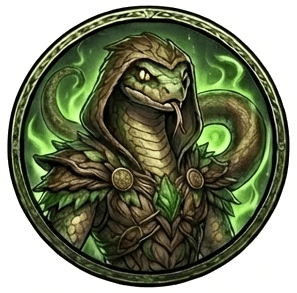
Before the first human drew breath, before the kingdoms rose from mud and ambition, Dermaz coiled in the roots of the World-Tree—patient, eternal, dreaming in scales.
He is older than memory. The creatures of Cordragia worshipped him when worship was still instinct rather than ritual. They left offerings of fruit and flesh at the mouths of caves where his children nested. They painted his likeness on stone walls with pigments mixed from blood and berries. They understood, in the wordless way that prey understands predator, that the forests belonged to him.
Dermaz is the god of the wild places. His domain is everywhere that civilization has not yet corrupted—the deepest thickets, the poisonous swamps, the vine-choked ruins of temples older than any human tongue. His scales shift between emerald and obsidian depending on his mood. His eyes are golden, slitted, capable of seeing heat itself. When he speaks, his voice is the rustle of leaves before a storm, the hiss of rain on hot stone, the crack of branches beneath something massive moving unseen.
For ten thousand years, he watched humanity spread across Cordragia like a disease.
At first, they were merely another animal—clever apes who had learned to sharpen sticks and fear the dark. Dermaz tolerated them as he tolerated all creatures. They hunted. They gathered. They lived and died within the natural order, their bones returning to feed the soil that fed the trees that sheltered his children.
Then they discovered fire.
Fire was the first betrayal. They used it to push back the darkness, to burn clearings in his sacred groves, to cook the flesh of creatures they were too weak to eat raw. The smoke rose like a challenge, and Dermaz stirred in his ancient sleep for the first time in millennia.
But fire was only the beginning.
They built walls. Cities. Kingdoms. They dammed his rivers and drained his swamps. They felled forests that had grown for ten thousand years to build ships that sailed to distant shores, spreading their plague to places that had never known their touch. They poisoned the water with their waste. They poisoned the air with their forges. They poisoned the earth itself with their endless need for more, more, more.
Dermaz watched a forest he had tended since the world was young burn to ash so that humans could graze cattle on the land. He felt the death of every tree, every creature that lived in their branches, every insect that burrowed in their bark. The pain was exquisite. It woke something in him that had slumbered since the gods first shaped the world.
Rage.
Not the hot rage of fire, which burns bright and dies quickly. The cold rage of a serpent—patient, calculating, absolute. Dermaz did not strike immediately. He is not capable of acting in haste. Instead, he observed. He learned. He came to understand humanity not as individual creatures but as a collective sickness, each generation worse than the last.
They call themselves stewards of the earth. Guardians of nature. They plant gardens and call themselves virtuous while their cities sprawl ever outward, consuming everything. They domesticate his wild creatures and call it love. They cage his wolves, his bears, his serpents, and charge coins to gawk at them. They have forgotten what it means to be prey.
Dermaz intends to remind them.
He has emerged from the deep places now, wearing a form that humans can perceive—though they perceive it imperfectly. To most, he appears as a figure of impossible height, his features shifting between human and serpentine depending on the light. His skin is scaled but smooth, cold to the touch. His tongue flickers when he speaks, tasting lies on the air.
The creatures of the wild follow him without question. Wolves and bears and things that have no names in any human language. Serpents beyond counting—constrictors thick as tree trunks, vipers whose venom can dissolve steel, ancient wyrms that make dragons look like garden snakes. The forest itself bends to his will. Vines grow where he commands. Thorns spring from soil that was barren moments before. The underbrush parts to let him pass and closes behind him like a trap.
The Crimson Chest calls to him not for its gold—he has no use for metal, no interest in wealth. He seeks the dragon's blood within, the essence of the last great wyrm that once ruled Cordragia before humanity rose. That blood, mixed with the venom of a god-serpent, can do what no army ever could.
It can unmake civilization itself.